
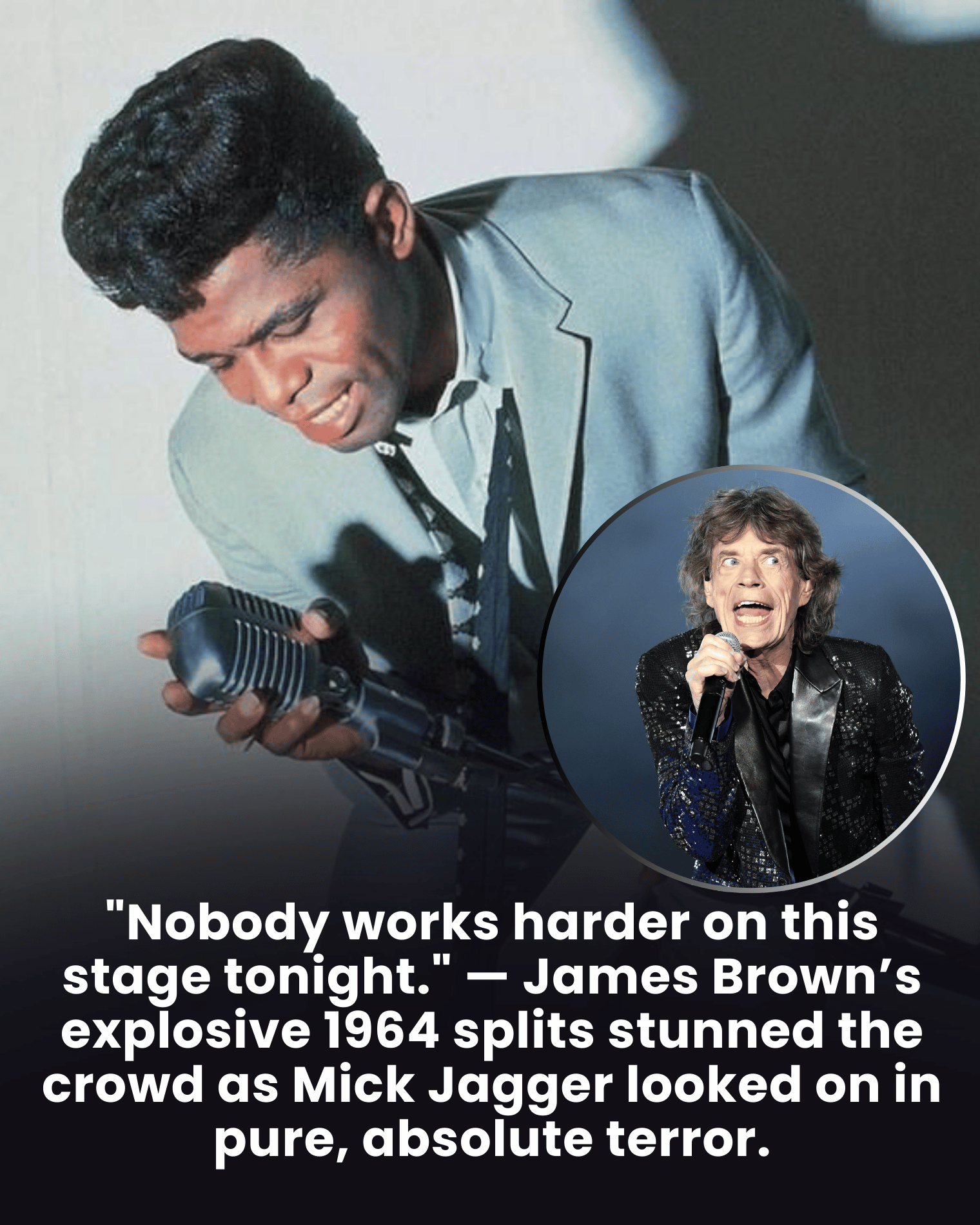
In 1964, the T.A.M.I. Show brought together some of the biggest rising stars in music for a filmed concert that would become legendary in rock and soul history. The lineup was stacked with talent, including The Beach Boys, Chuck Berry, and a young British band beginning to conquer America—the Rolling Stones. Yet by the end of the night, one performance overshadowed them all.
That performance belonged to James Brown.
Known as the "Godfather of Soul," Brown had already developed a reputation as one of the most electrifying live performers in the world. His concerts were not just musical events; they were athletic displays of rhythm, endurance, and theatrical intensity. Every move, every scream, every drop to the floor was delivered with a level of energy that few artists could match.
But at the T.A.M.I. Show, Brown had an additional motivation.
Originally scheduled to perform before the Rolling Stones, he reportedly felt insulted that a relatively new British band would appear after him in the lineup. Rather than protest publicly, Brown decided to answer the situation the only way he knew how: by delivering a performance so explosive that no act would want to follow it.
When he stepped onto the stage, dressed sharply and backed by his tight, disciplined band, the audience had little idea what was about to unfold.
The moment the music began, Brown launched into a whirlwind of movement. His band drove the rhythm forward while he danced, spun, and shouted with relentless intensity. Sweat poured from his face as he commanded every inch of the stage.
Then came the signature moment that defined the performance.
During the dramatic finale of "Please, Please, Please," Brown collapsed to his knees, overwhelmed with emotion as if the music itself had drained every ounce of energy from him. An assistant rushed forward and draped a cape over his shoulders, guiding him away from the microphone as the band continued to play.
But just as he seemed ready to leave the stage, Brown threw the cape aside and charged back to the microphone.
The cycle repeated again and again—each return more intense than the last. Finally, with the music surging, Brown leapt into the air and landed in a perfect split, sliding across the stage with astonishing precision.
The crowd erupted.
Backstage, members of the Rolling Stones watched the performance in disbelief. Among them was Mick Jagger, who would later admit that seeing Brown perform that night left him stunned. The British singer understood immediately what had happened: James Brown had just delivered one of the most powerful performances ever seen on a concert stage.
Jagger reportedly turned to someone nearby and asked how they were supposed to follow that.
In many ways, the moment represented a clash of musical cultures. The Rolling Stones would go on to become one of the biggest rock bands in history, but that night belonged entirely to the Godfather of Soul. Brown's explosive stage presence set a standard for live performance that would influence generations of musicians across genres.
James Brown continued performing for decades afterward, maintaining the same relentless energy that made him famous. When he passed away in 2006 at the age of 73 from heart failure, the world lost one of the most influential performers in music history.
Even beyond his music, Brown's life remained complex and often controversial. His personal affairs—including multiple marriages and a $100 million estate—became the subject of lengthy legal battles that lasted for years after his death.
Yet when fans and musicians remember him today, they often think back to moments like the T.A.M.I. Show in 1964. It was a night when one man stepped onto a stage determined to prove a point—and left behind a performance so electrifying that even future rock legends were left standing in stunned silence.